
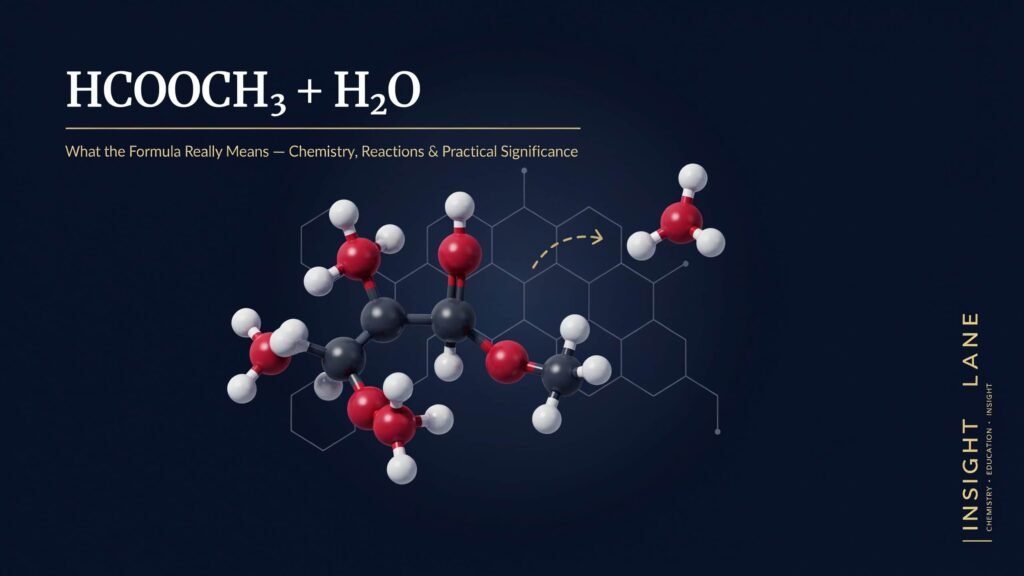

At first glance, HCOOCH CH2 H2O looks like a conventional chemical formula. It isn’t.
That distinction matters. Chemistry depends heavily on how atoms are connected, and a small formatting difference can change the identity of a substance completely. In standard chemical databases, “HCOOCH CH2 H2O” is not recognized as the formula of one well-defined, stable compound. Instead, the expression appears to be an informal or incomplete shorthand involving a formate/ester fragment, a CH₂ unit, and H₂O.
The closest clearly identifiable compound suggested by the notation is methyl formate, HCOOCH₃, also called methyl methanoate or formic acid methyl ester. NIST lists methyl formate with the molecular formula C₂H₄O₂, molecular weight 60.0520 g/mol, and CAS Registry Number 107-31-3.
The CH₂ portion introduces another layer of chemistry. Written as :CH₂, methylene is the parent carbene: a highly reactive species with two nonbonding electrons. IUPAC distinguishes its singlet and triplet electronic states.
And H₂O, of course, is water—but in organic chemistry water can be much more than a solvent. It can participate directly in hydrolysis, hydration, proton-transfer reactions, and equilibrium processes.
So the real value of studying HCOOCH CH2 H2O isn’t memorizing an unusual string of symbols. It’s learning how to recognize when a chemical expression represents a molecule, a reaction mixture, a structural fragment, or simply an incorrectly written formula.
What Is HCOOCH CH2 H2O?
The first thing to establish is that HCOOCH CH2 H2O should not automatically be treated as one molecule.
There are several plausible interpretations of the notation, but they don’t have equal chemical validity.
| Written component | Most likely interpretation | Chemical significance |
|---|---|---|
| HCOOCH | Incomplete representation of a formate ester | Points toward formate/methyl-formate chemistry |
| CH₂ | Methylene unit or methylene fragment | May be part of a larger molecule or, as :CH₂, a carbene |
| H₂O | Water | Solvent, reactant, hydrolysis reagent, or hydrogen-bonding partner |
| HCOOCH₃ | Methyl formate | A real, well-characterized ester |
| :CH₂ | Methylene carbene | Highly reactive transient species |
The strongest identification is HCOOCH₃ = methyl formate. NIST specifically records HCOOCH₃ as a synonym for methyl formate and gives its standard chemical identifiers.
By contrast, writing HCOOCH₂ without specifying the remaining bonding environment does not produce the normal formula for methyl formate. This is one reason searches for the exact phrase can produce conflicting explanations.
The formatting problem
Consider these three expressions:
- HCOOCH₃
- HCOOCH₂OH
- HCOOCH₂
They look similar, but they represent very different chemical situations.
The first is methyl formate.
The second represents a different molecular structure.
The third is incomplete unless the rest of the molecular connectivity is supplied.
This is why chemical notation should never be interpreted purely by visual similarity.
Understanding the HCOO Portion
The fragment HCOO is associated with the formate portion of formic acid and formate esters.
Formic acid has the structure:
HCOOH
Its ester with methanol is methyl formate:
HCOOH + CH₃OH ⇌ HCOOCH₃ + H₂O
That equation is much more chemically informative than the compressed search phrase because it explicitly shows the atoms and their connectivity.
Methyl formate is the simplest ester derived from formic acid. NIST identifies it as methyl methanoate, formic acid methyl ester, and HCOOCH₃.
This distinction is particularly useful when researching the phrase HCOOCH CH2 H2O, because several low-quality online explanations incorrectly treat the entire string as though it were a recognized molecular formula.
It isn’t.
The scientifically safer approach is to identify the chemically valid pieces first.
Methyl Formate: The Most Concrete Chemical Identity Behind the Search
If your search for HCOOCH CH2 H2O is actually referring to methyl formate and water, then the chemistry becomes much clearer.
5
Methyl formate belongs to the ester family. Its molecular formula is C₂H₄O₂, and its molecular weight is approximately 60.0520 g/mol. NIST also provides thermochemical, spectroscopic, chromatographic, and other physical-property data for the compound.
The basic structure can be represented as:
H–C(=O)–O–CH₃
That arrangement contains:
- a carbonyl group,
- an ester oxygen,
- a methyl group,
- and the formyl hydrogen attached to the carbonyl carbon.
The ester linkage is the chemically important feature when water enters the picture.
What Happens When Methyl Formate Meets Water?
The classic reaction is ester hydrolysis.
In simplified form:
HCOOCH₃ + H₂O ⇌ HCOOH + CH₃OH
The ester is converted into:
- formic acid (HCOOH)
- methanol (CH₃OH)
Water supplies the atoms involved in breaking apart the ester functionality, although the detailed mechanism depends on whether the reaction is acid- or base-catalyzed.
This is likely the most useful interpretation if someone has encountered HCOOCH CH2 H2O while studying ester chemistry.
PubChem’s methyl formate record also documents hydrolysis of methyl formate to methanol and formic acid, including information / fate and biological transformation.
The Mechanism of Ester Hydrolysis
Understanding the mechanism is more valuable than simply memorizing the products.
Activation of the ester
Under acidic conditions, protonation can increase the electrophilic character of the carbonyl carbon.
That makes it easier for water to attack.
Nucleophilic attack
Water acts as a nucleophile and attacks the carbonyl carbon.
A temporary tetrahedral intermediate forms.
Proton transfers
Protons move between oxygen atoms during the reaction.
These transfers help turn the potential leaving group into a more favorable species.
Collapse of the intermediate
The tetrahedral intermediate rearranges and the ester bond is ultimately cleaved.
Product formation
The reaction produces the corresponding carboxylic acid and alcohol under the appropriate conditions.
For methyl formate, those products are formic acid and methanol.
The important lesson is that H₂O isn’t merely decorative in the equation. It participates in the chemistry.
Where Does CH₂ Fit Into HCOOCH CH2 H2O?
This is where the original notation becomes considerably more ambiguous.
CH₂ can mean several different things depending on context.
It can be:
- A methylene group inside a larger molecule.
- A structural shorthand in a condensed formula.
- The reactive species :CH₂, known as methylene or methylidene.
- Part of a compound such as CH₂OH, CH₂CH₃, or CH₂=CH₂.
These aren’t interchangeable.
CH₂ as a Structural Unit
In ordinary organic chemistry, CH₂ often appears inside larger structures.
For example:
CH₃–CH₂–OH
contains a CH₂ group but isn’t a methylene carbene.
Likewise:
CH₂=CH₂
is ethene, where each carbon is part of a stable molecule.
So seeing CH₂ doesn’t automatically mean that free methylene exists.
CH₂ as Methylene Carbene
When written as :CH₂, methylene has an entirely different meaning.
IUPAC defines carbenes as electrically neutral species in which a carbon atom is covalently bonded to two groups and bears two nonbonding electrons. Methylene, H₂C:, is the parent example.
The electronic structure is especially important because methylene can exist in singlet and triplet states.
IUPAC’s nomenclature resources likewise recognize methylidene as the systematiccwhile “carbene” and “methylene” remain commonly used names.
This species is extremely reactive.
That means the statement sometimes found online that simply mixing “CH₂ + H₂O” gives methanol should not be treated as an ordinary laboratory recipe.
A free methylene carbene doesn’t behave like a stable bottleable chemical.
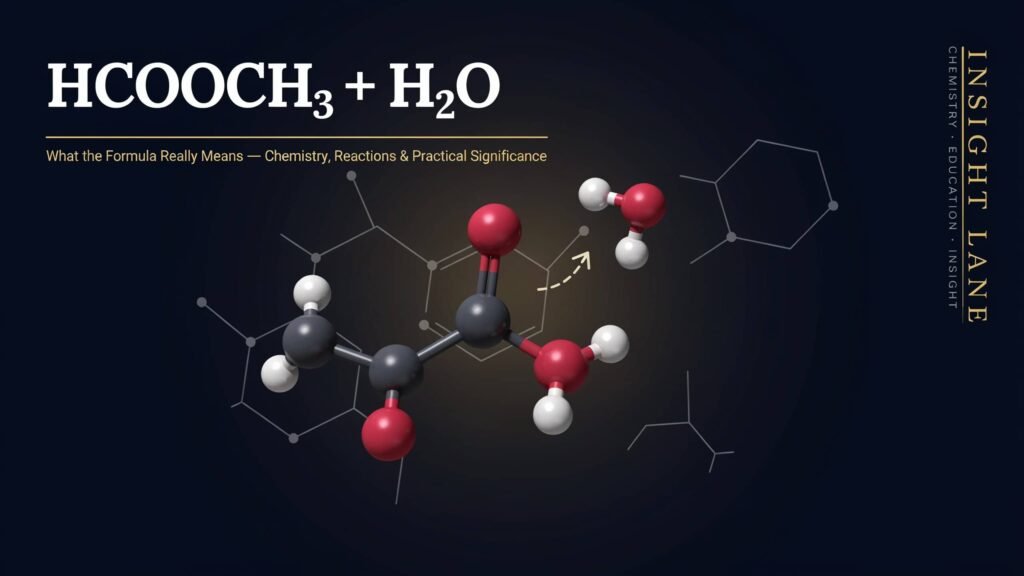
Why “CH₂ + H₂O → CH₃OH” Needs Context
At a superficial level, someone might write:
CH₂ + H₂O → CH₃OH
because the atoms balance.
But balanced atoms aren’t enough to establish a realistic reaction mechanism.
Chemical feasibility depends on:
- electronic structure,
- reaction pathway,
- energy,
- intermediates,
- spin state,
- solvent,
- temperature,
- catalysts,
- and competing reactions.
Methylene is a highly reactive carbene, not ordinary methane with two hydrogens removed in a simple arithmetic sense.
This is one of the biggest conceptual traps associated with the keyword HCOOCH CH2 H2O.
A chemical equation can be atom-balanced and still fail to describe what actually happens under ordinary conditions.
HCOOCH CH2 H2O and Ester Chemistry
If the intended subject is methyl formate interacting with water, the most defensible chemistry centers on ester hydrolysis.
Acid-catalyzed hydrolysis
Acid increases the electrophilicity of the ester carbonyl and facilitates the sequence of proton transfers and bond cleavage.
The reaction is generally reversible.
Base-catalyzed hydrolysis
In basic conditions, hydroxide attacks the ester and ultimately produces a carboxylate salt rather than simply leaving formic acid in the reaction mixture.
Conceptually:
ester + OH⁻ → carboxylate + alcohol
For methyl formate, the corresponding carboxylate is formate.
This distinction matters because the final chemical form depends strongly on reaction conditions.
Esterification: The Reaction Going in the Opposite Direction
Hydrolysis is only half of the story.
The reverse process is esterification.
Formic acid can react with methanol to form methyl formate and water:
HCOOH + CH₃OH ⇌ HCOOCH₃ + H₂O
This is a classic example of an equilibrium reaction.
The reaction direction depends on the conditions and relative concentrations of reactants and products.
That simple observation explains why water matters so much in ester chemistry.
If water accumulates, it can favor the hydrolysis side of an equilibrium. If water is removed during ester formation, the equilibrium can be shifted toward ester production.
Why Water Matters More Than It Appears
Water has an unusually broad role in chemistry.
It can act as:
- a solvent,
- a nucleophile,
- a proton donor,
- a proton acceptor,
- a reaction medium,
- a hydration partner,
- and a product of condensation reactions.
For methyl formate, water is directly relevant to hydrolysis.
For a methylene carbene, water represents a highly reactive environment rather than a simple inert solvent.
For a larger organic molecule containing CH₂, water might simply be the reaction medium.
So the meaning of H₂O can’t be determined without knowing the molecular structure and reaction conditions.
Is HCOOCH CH2 H2O One Chemical Compound?
No—not as written.
That is the clearest answer.
There is no standard chemical identity established by the exact string HCOOCH CH2 H2O comparable to recognized compounds such as methyl formate, water, methanol, or formic acid.
A PubChem entry does exist for a methyl formate–water species, listed as “methyl formate;hydrate,” with formula C₂H₆O₃, but that is a distinct database entry and doesn’t validate the exact phrase “HCOOCH CH2 H2O” as a single conventional molecular formula.
This is a good example of why chemical database identifiers are useful.
A legitimate compound should ideally be traceable through things such as:
- molecular formula,
- systematic name,
- CAS Registry Number,
- InChI,
- InChIKey,
- structural representation.
Methyl formate, for example, has all of these identifiers documented by NIST.
Common Misinterpretations of HCOOCH CH2 H2O
The phrase has generated several recurring misunderstandings online.
It is a single molecule
This is the most basic error.
The notation doesn’t provide enough structural information to establish one unique molecule.
HCOOCH means methyl formate
Only when the formula is properly completed as HCOOCH₃.
The missing subscript matters.
CH₂ always means free methylene
It doesn’t.
A CH₂ group is extremely common in stable organic molecules.
Free :CH₂, however, is a reactive carbene.
Water automatically means hydration
Not necessarily.
Water can participate in hydrolysis, acid-base chemistry, solvation, hydrogen bonding, or other processes.
An atom-balanced reaction must happen spontaneously
Chemical reactions require energetically and mechanistically plausible pathways.
Balancing an equation is only the beginning.
Practical Example: Reading the Formula Like a Chemist
Imagine a student encounters:
HCOOCH CH2 H2O
Instead of immediately searching for a product, a better approach is to ask four questions.
Is this a complete molecular formula?
Probably not.
What recognized compound resembles HCOOCH?
HCOOCH₃, methyl formate.
What could CH₂ mean?
It could be a structural methylene unit or, with appropriate notation, a methylene carbene.
What is H₂O doing?
It could be a solvent, reactant, product, or component of an association.
That method prevents an enormous number of chemistry mistakes.
Properties and Chemical Context of Methyl Formate
Methyl formate is a genuine, well-characterized substance.
According to NIST:
| Property | Methyl formate |
|---|---|
| Common name | Methyl formate |
| IUPAC-related name | Methyl methanoate |
| Formula | C₂H₄O₂ |
| Molecular weight | 60.0520 g/mol |
| CAS number | 107-31-3 |
| Structure | HCOOCH₃ |
NIST maintains data covering its thermochemistry, phase-change behavior, spectroscopy, mass spectrum, gas chromatography, and related properties.
This makes methyl formate a much firmer scientific reference point than the ambiguous keyword itself.
Environmental Fate of Methyl Formate
The environmental behavior of methyl formate also demonstrates why its reaction with water deserves attention.
PubChem’s data indicate that hydrolysis is an important environmental fate process for methyl formate. The database cites estimated hydrolysis behavior under different pH conditions and notes that volatilization can also occur.
This doesn’t mean that every environmental situation follows the same timeline. Environmental chemistry depends on:
- pH,
- temperature,
- moisture,
- concentration,
- microbial activity,
- atmospheric conditions,
- and the physical setting.
The figures in database records should therefore be interpreted as estimates or context-specific data rather than universal constants.
Industrial and Laboratory Relevance
Methyl formate has appeared in chemical manufacturing and organic synthesis contexts.
PubChem records its production and use in areas including chemical synthesis and solvent-related applications, while also documenting environmental and occupational exposure considerations.
The broader significance of the chemistry is that ester hydrolysis is one of the foundational transformations in organic chemistry.
Once a student understands methyl formate hydrolysis, the same conceptual framework can be applied to many other esters.
That’s why this seemingly obscure keyword can actually lead to a useful lesson in reaction chemistry.
Benefits of Understanding This Chemistry
Studying the chemistry behind HCOOCH CH2 H2O has several practical benefits.
Better chemical notation
You learn to distinguish complete molecular formulas from fragments.
Stronger reaction prediction
You begin identifying functional groups before predicting products.
Better mechanism understanding
You see why water can participate in bond-breaking and bond-forming processes.
Fewer laboratory mistakes
Understanding chemical identity helps prevent confusion between stable compounds and reactive intermediates.
Better scientific research
You become less dependent on poorly written search results and more capable of checking authoritative chemical databases.
Limitations of the HCOOCH CH2 H2O Notation
The phrase itself has serious limitations.
It doesn’t tell you:
- exact connectivity,
- charges,
- stereochemistry,
- reaction conditions,
- concentrations,
- catalysts,
- temperature,
- or whether CH₂ is a group or reactive carbene.
For serious chemical work, that isn’t enough information.
A researcher would normally want a structural formula or a fully specified reaction equation.
How to Write It Correctly
If you’re writing about methyl formate, use:
HCOOCH₃
If you’re discussing methyl formate hydrolysis, use:
HCOOCH₃ + H₂O ⇌ HCOOH + CH₃OH
If you’re discussing methylene carbene, use:
:CH₂
If you’re talking about an ordinary methylene group within an organic compound, show its surrounding bonds, such as:
R–CH₂–R′
That small improvement in notation can completely change the scientific clarity of the discussion.
Safety Considerations
Methyl formate is a real chemical substance and should be treated accordingly rather than as an abstract formula.
Chemical handling should always rely on the current Safety Data Sheet (SDS), appropriate laboratory controls, ventilation, protective equipment, and institutional procedures.
The ambiguity surrounding HCOOCH CH2 H2O is itself a safety reason to identify chemicals precisely.
A laboratory should never select a substance based solely on an incomplete internet search phrase.
The same caution applies even more strongly to reactive intermediates such as carbenes.
What Students Should Remember
If you’re studying this topic for an exam, don’t memorize the keyword as though it were a normal compound.
Remember these relationships:
HCOOH → formic acid
CH₃OH → methanol
HCOOCH₃ → methyl formate
H₂O → water
:CH₂ → methylene carbene
And for methyl-formate hydrolysis:
HCOOCH₃ + H₂O ⇌ HCOOH + CH₃OH
That gives you a chemically meaningful framework instead of an ambiguous string of symbols.
HCOOCH CH2 H2O vs. Related Chemical Expressions
| Expression | What it represents | Confidence |
|---|---|---|
| HCOOCH₃ | Methyl formate | Clearly defined |
| H₂O | Water | Clearly defined |
| HCOOH | Formic acid | Clearly defined |
| CH₃OH | Methanol | Clearly defined |
| :CH₂ | Methylene carbene | Clearly defined when carbene notation is intended |
| R–CH₂–R′ | Methylene group within a molecule | Context-dependent |
| HCOOCH CH2 H2O | Ambiguous shorthand | Not a standard single compound |
This distinction is perhaps the most important takeaway from the entire topic.
Why Search Results Can Be Misleading
A search engine may return dozens of pages that confidently define HCOOCH CH2 H2O as a particular compound.
Confidence, however, isn’t the same thing as chemical evidence.
Some web pages use the phrase as though it were a standardized formula, while others interpret it as methyl formate plus methylene plus water. Those interpretations shouldn’t automatically be treated as authoritative.
For scientific questions, primary or institutional resources are stronger starting points.
NIST identifies methyl formate unambiguously as C₂H₄O₂ / HCOOCH₃, while IUPAC provides the authoritative terminology for methylene and carbenes.
That evidence-based approach is particularly important when an unusual keyword has become popular online without a corresponding standardized chemical name.
Frequently Asked Questions
Is HCOOCH CH2 H2O a real chemical compound?
Not as a standard, uniquely defined compound. The notation is ambiguous and appears to combine a formate/ester fragment, a CH₂ unit, and water. If methyl formate is intended, the correct formula is HCOOCH₃. NIST identifies methyl formate as a distinct compound with formula C₂H₄O₂.
What is HCOOCH₃?
HCOOCH₃ is methyl formate, also known as methyl methanoate or formic acid methyl ester. It is an ester with molecular formula C₂H₄O₂ and molecular weight approximately 60.0520 g/mol.
What happens when methyl formate reacts with water?
Methyl formate can undergo hydrolysis to produce formic acid and methanol:
HCOOCH₃ + H₂O ⇌ HCOOH + CH₃OH
The reaction can be influenced or accelerated by acidic or basic conditions.
Does CH₂ mean methylene?
It can, but context matters. A CH₂ group commonly occurs inside stable organic molecules. When written as :CH₂, methylene refers to a carbene, a highly reactive species recognized by IUPAC.
Is CH₂ + H₂O a normal reaction?
Not in the simplistic sense sometimes suggested online. Free methylene is a highly reactive carbene, so its chemistry must be discussed in terms of actual reaction pathways and conditions rather than simply balancing atoms.
Is HCOOCH the same as methyl formate?
No. Methyl formate is properly written HCOOCH₃. The incomplete expression HCOOCH does not provide the same complete molecular specification.
Why is water important in ester chemistry?
Water can participate directly in ester hydrolysis and can also influence equilibrium between esterification and hydrolysis. It can therefore function as both a reaction participant and a medium.
Where can I verify methyl formate’s chemical identity?
NIST Chemistry WebBook provides authoritative reference data for methyl formate, including its formula, molecular weight, identifiers, spectra, and thermochemical information.
Conclusion
The real story behind HCOOCH CH2 H2O is less about an exotic chemical and more about the importance of precise chemical notation.
The expression doesn’t identify one established compound. Instead, it appears to bring together pieces associated with formate or ester chemistry, a CH₂ fragment, and water. Once those pieces are separated, the chemistry becomes much easier to understand.
The most concrete compound hiding behind the notation is methyl formate, HCOOCH₃—a well-characterized ester documented by NIST. Its interaction with water provides a straightforward introduction to ester hydrolysis, while the CH₂ portion opens the door to a different subject: the chemistry of methylene and carbenes.
That’s the broader lesson worth carrying forward. In chemistry, a missing subscript, an omitted bond, or an unexplained fragment isn’t a cosmetic problem. It can change the identity of the substance being discussed.
When you encounter HCOOCH CH2 H2O, don’t rush to assign it a name. Break it apart, identify each chemically valid component, check the connectivity, and verify the result against reliable scientific references. That habit is far more useful than memorizing one ambiguous formula.
What do you feel about this post?

Like

Love

Happy

Haha

Sad